
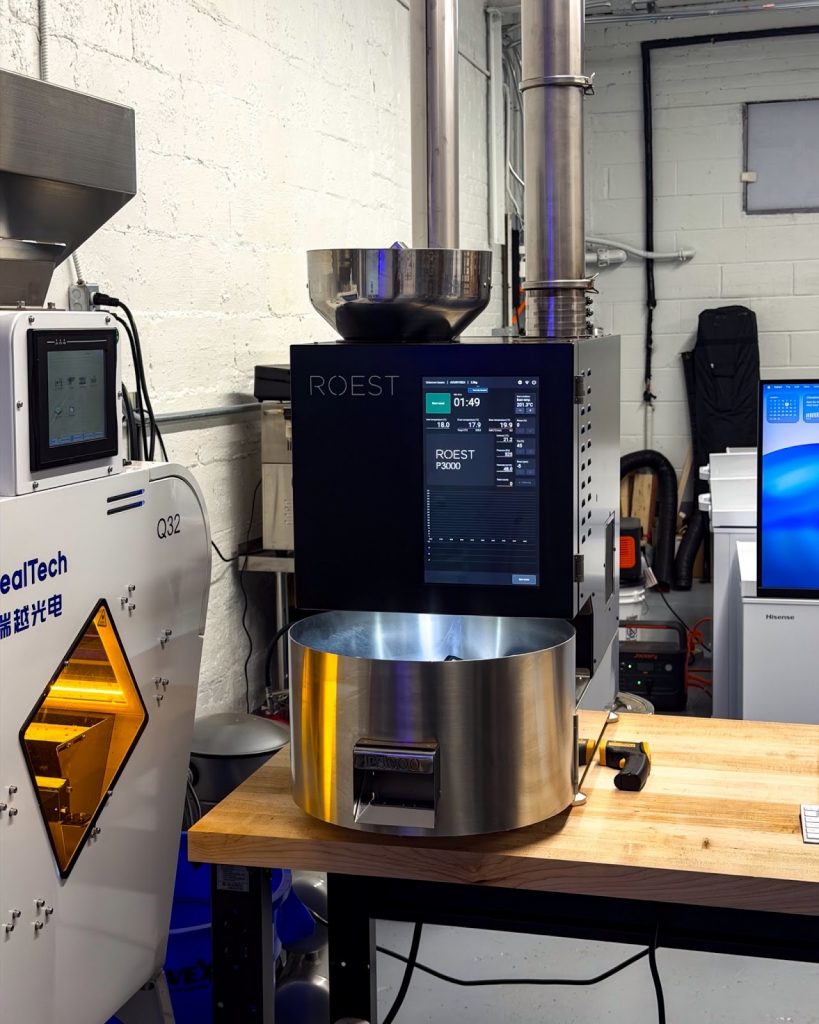
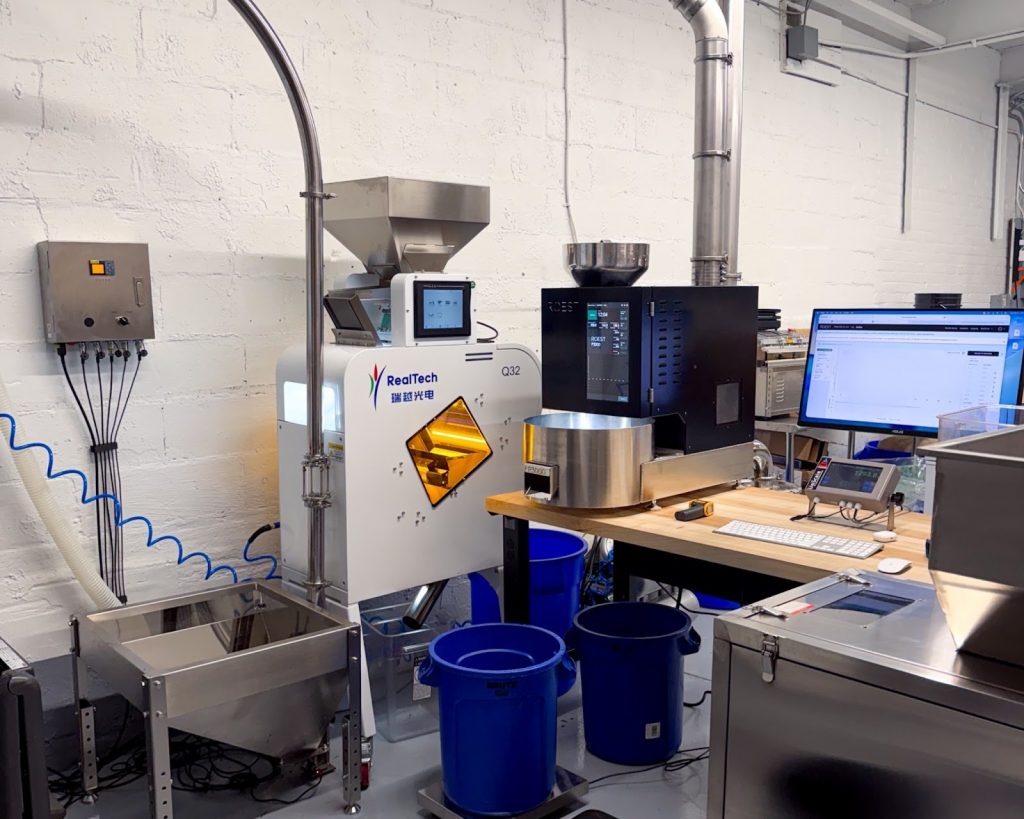
ABOVE: Aviary’s roastery in Cleveland, Ohio in March 2026. Here, coffee flows from right to left, requiring only one operator for the entire production line as coffee moves from a net-weigher dispensing 3000.0g of green coffee to the P3000; from the P3000 to an Arlyn scale; from the scale to the RealTech Q32 color sorter; from the color sorter to the Sovda destoner, lift and Precision Fill Mini; and finally, to a band sealer.
Early in the planning stages for Aviary, I decided that I wanted to roast using an electric coffee roaster.
It’s a somewhat unconventional proposition: though there’s no discernible cup difference between coffees roasted using gas versus electric (or wood), burning fossil fuels is an efficient way to produce heat, and most of the roasters on the market at the time were—and still are—built to use them. And, in the state of Ohio, where Aviary is currently based, fossil fuels are inexpensive. Natural gas, the primary fuel for roasters in the U.S., flows in capillaries buried deep beneath the state’s shale bedrock. Hydraulic fracturing—the technique used to liberate the gas in Ohio—is destructive to local ecosystems, contaminates groundwater, causes earthquakes, and is part of a wholesale political effort to sell off public lands for oil extraction. Plus: the burning of fossil fuels is a direct cause of climate change—and has been shown to increase respiratory ailments such as asthma, leading to states like New York banning the use of gas as a heating fuel in new residential construction.
The fossil fuel industry is, suffice to say, problematic. So Loring—which I’d roasted on for most of my career and love to use—was out.
Ohio’s deregulated energy economy, though, meant that I could select my own energy generation supplier and cheaply purchase electricity generated only using clean energy sources like wind and solar, making the prospect of my idealism more economically viable.
But at the time, there were scant options available for commercial-scale electric coffee roasters, let alone with the feature set that I desired in a production roaster. I’d heard of Roest’s forthcoming production machine and reached out to the company, but as its timeline for release slipped past Aviary’s launch date, I opted for a Stronghold S9X, a Korean-made air roaster with an unusual design and footprint, notable quality of life features, and multiple means of controlling and manipulating heat transfer. Notably, one of these variables included halogen, a type of heat application I hadn’t seen on any other roaster but one that intrigued me greatly. From March 2024 until December 2025, I used that roaster as Aviary’s sole production machine.
But now, entering Aviary’s third year and forecasting 50% year-over-year growth in roasting volume, I’ve sold it, replacing it with a much smaller machine: the Roest P3000.
Sections
Introduction
Disclaimer
The problem
P3000 overview
Quality and control
Speed and efficiency
Consistency
Feedback and flaws
Reliability?
Parting thoughts
Ever since I teased the arrival of the machine to my roastery in December, my inbox has been flooded by requests from roasters and roasting companies for a post about the P3000. Curiosity about the machine was understandable: its long development cycle and delayed release plus praise from early users followed by a Best New Product win at SCA Expo 2025 generated an enormous amount of interest—and hope—in the machine. I promised that I would write about it—once I had sufficient experience running coffee through it—just as I had once intended to write about the Stronghold and my decision to purchase it for Aviary.
In my more-than-fifteen years roasting coffee, I’ve worked on a variety of equipment and turned coffee brown in as many ways as I could imagine. But as the operator of a boutique roasting business—one where I execute production myself in addition to management and administrative functions—I valued and prioritized automation features, speed of routine cleaning and maintenance, and roast quality as I made my procurement decisions.
Budget is, I am privileged to say, a secondary concern for Aviary: I’d rather invest in the suitable equipment for the job to keep my operating budget low and give me the flexibility to operate the way I want to operate. It’s a luxury that I have—running Aviary with very low overhead and reinvesting what profits I made back into the company, subsidizing any gaps through my primary income from my work as a consultant.
There’s been some speculation about a financial relationship between me and the Roest company—no doubt owing to the excitement and frequency with which I speak about their sample roasters—the preferred roasters in my lab. But while I have apparently imbibed the Roest Kool-Aid, I hope to dispel that myth now: I have never been paid by Roest, nor have I agreed to be paid at some point in the future. When I speak about machines or my experience with the company, I do so freely and without a motive for profit. The observations and findings I share are my own.
It’s a privilege, too, to be on the bleeding edge of technology and to be able to take on the associated risk and expense of adopting these tools—but I share my experiences here, as I have in the past, to better guide and inform the conversation.
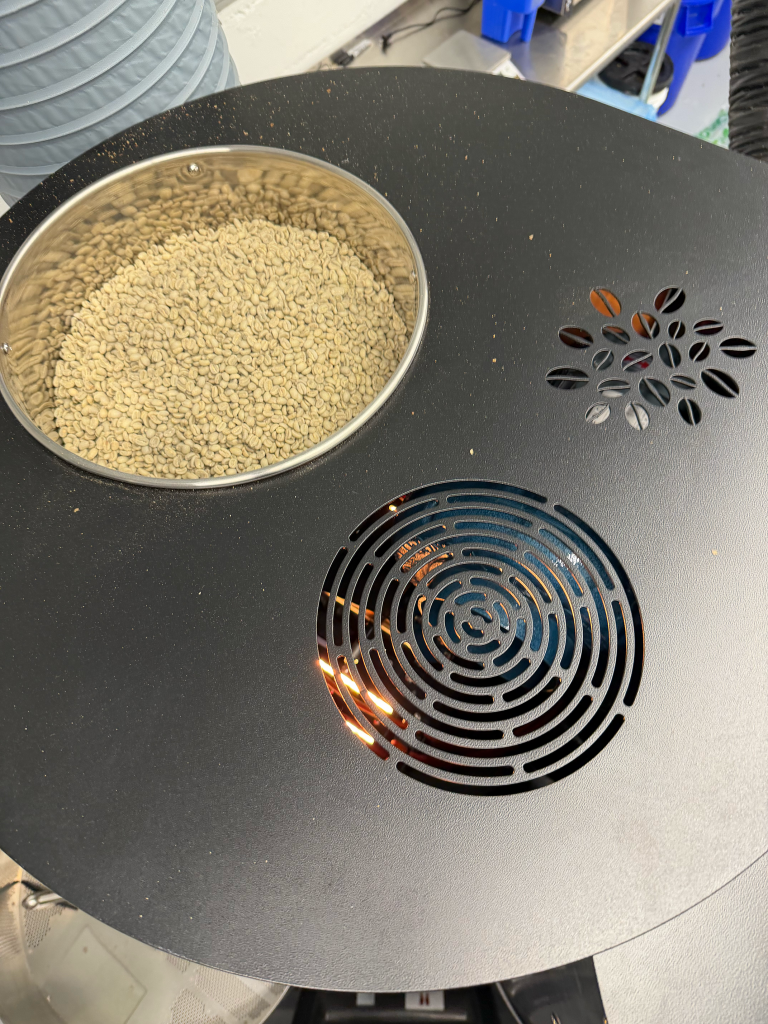
After two years of roasting with the Stronghold, I grew increasingly annoyed about certain aspects of the machine and the decisions made by its engineers. Some of my grievances were petty—like my irritation with the top of the machine’s chassis ventilation ports, which are directly next to the green hopper and precisely shaped to allow green coffee to fall into the abyss of the machine if an operator is careless, hurried or clumsy—while others were more critical.
An operator coming from a traditional drum roaster might feel at home operating the Stronghold, but I was frustrated with the machine’s control system, which allows a user to adjust each of the machine’s settings for agitation speed, blower speed, heating element, drum heater, and halogen on an arbitrary 0-10 scale using an Android tablet built into the machine. This control mechanism required that I manually adjust each parameter through a roast, capturing the profile to enable me to run on Replication mode for automated roasting later.
On the Stronghold—as on Lorings and traditional drum roasters—inlet temperatures are a dependent variable resulting from setting a burner level (the independent variable). We set the power level and the system delivers that amount of power, producing hot air of some indeterminate temperature as a result. But the Stronghold’s control system doesn’t account for variance in supply voltage, didn’t allow granularity of adjustment and didn’t allow for setting temperature targets directly. In times when there was greater demand on the electrical supply—such as when the line at a nearby metal stamping factory was operating—I’d see voltage dip and would have to use higher power levels, also limiting my theoretical usable range of power.
Without installing an expensive power stabilizer (I was quoted $15-20k for this, on top of the $4,500 380v step-up transformer and $5,000 in electrical work I’d already paid to get the roaster up and running), I was forced to live with the variability. Even measuring supply voltage ahead of a day of production, though, I discovered that the voltage could sag by 10% through the day. This meant that a roast that I might normally run peaking at setting “9” might suddenly lag when roasted manually. If I were roasting manually and didn’t account for that voltage dip, I’d potentially waste a batch—or else accidentally produce coffee with a profile other than intended. And because it lacked granular control—I could only set power in half steps—a 10% dip in voltage meant that if I used power setting 9.5 instead of 9, I’d overshoot.
The machine’s automation system, which the company calls “Auto-Replication” and markets as being able to produce “perfect replication beyond human capabilities,” merely manipulates air temperature in the roaster in an attempt to force the coffee’s surface temperature reading (the result of a software-smoothed IR sensor reading taken from the top of the drum—itself an unreliable narrator) to follow the captured roast, neglecting the time-temperature effects of other variables in the machine (such as drum temperature). The result of this automation approach is an astounding lack of consistency owing to the startup and between-batch protocols for the roaster, which too are automated, but programmed by the company. I had no visibility into those processes and could not further optimize them or, for example, disable the use of halogen.
The tablet used to control the roaster (through the company’s proprietary Roastware software) provides a live view of the roast, but notably absent are the ability to change the delta span for Rate of Rise or plot the exhaust temperatures on the log. The actuality of what occurs during a roast is a mystery; it’s a black box of software-smoothed lines and missing context.
And then there was the company itself, whose stubborn refusal to take user feedback seriously held the truly innovative hardware of the machine hostage to its software.
Stronghold refused to enable integrating their machines into Cropster or Artisan, for example, and instead in June 2025 delivered in response a system called Boost which lacked live roast logging or even the complete display of sensors from the roaster. This suggested to me that the company is not only deeply unserious about supporting its roasters in the U.S. market but also fundamentally misunderstands its customer. The Roastware update in 2025 changed the UI of the system and stripped back control, making it appear to me that Stronghold wanted the machine to be as simple to use as a microwave while neglecting the needs of professional users or more advanced roasters.
While I often did produce coffee I liked on the machine, I grew frustrated that I couldn’t do so as consistently as I liked or knew was theoretically possible.
So: after two years of shouting in the void to anyone who might listen, I’d had enough.

In December, an almost comically-small crate—scarcely larger than the one that once contained the much-smaller Arc S—arrived at my roastery, containing inside its plywood walls the 80kg Roest P3000.
On the bench, the machine is about the same size as a single-group Eversys Cameo. Even on my tallest days, the air I breathe is thick and closer to the earth than the sun, and so I was relieved by the smaller, shorter stature of the P3000 relative to the S9X, which required me to mount a step stool to load each batch of green above my head, through the top of the machine.
I located the machine on a shop table of standard 30” (76.2cm) depth to leave for the cooling tray to hang off the front and chaff bucket off the rear of the machine. Unlike the Stronghold, which features an auger and quench system to continuously expel chaff and unlocking 24/7 roasting, the P3000 requires a closed chaff bucket with an airtight seal to the machine—ensured through four tri-clamps and a silicone gasket—to enable the cyclone to separate chaff from exhaust air. The number of roasts the barrel can hold depends on the chaffiness of a coffee; with some, I’ve found it can roast up to 60kg without a change, but for others it was as few as 30kg of green. Emptying the chaff requires removing the clamps and dumping the bucket, but unlike on the smaller Roest sample roasters, this task can be performed with the machine running, provided that inlet temperatures are below 50 or 60ºC.
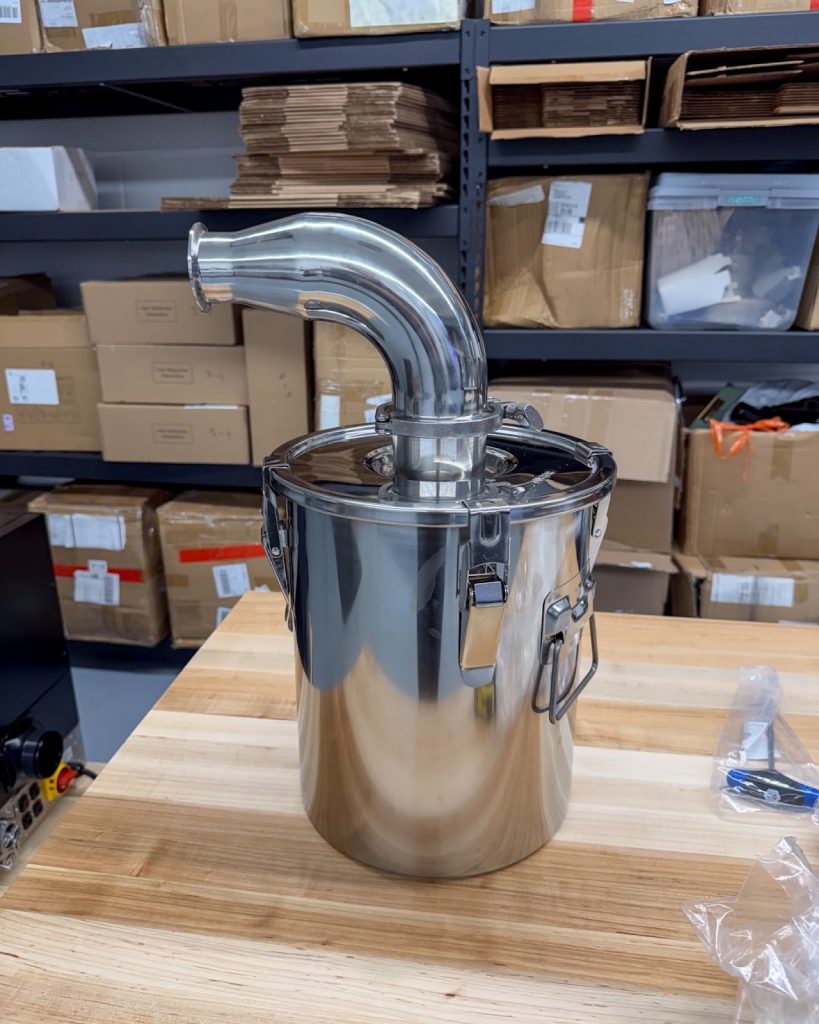
I’ve found that it’s trivial to accomplish this task during my standard between batch protocol, but it does add an additional step of intervention that the Stronghold system lacks. Roest’s support team advised me that it’s possible to replace the factory-provided chaff barrel for a custom-fabricated one—so I will likely retrofit this in the near term so as to ensure I have the ability to roast 60kg without needing to stop to empty chaff.
Being able to place the machine on a bench rather than on the ground means that I have added room to my workspace—with room below the roaster available for equipment, or a chair, or bins for receiving roasted coffee from the machine. It also means the machine is both easy to level and height-adjustable—by raising or lowering the table, I can raise or lower the working height of the machine, accommodating my preferences and comfort.
The two exhaust ports—one for the cooling tray and one for the hot exhaust—require standard 100mm ducting that is designed to withstand positive-pressure (and on the hot side, temperatures of up to 300c). When the soft ducting I’d temporarily harvested from the Stronghold and connected to the machine began to break down after 100 roasts, I replaced it with Nordfab ducting held together using tri-clamps and PTFE gaskets, braced by Unistrut just below the roof deck. This system facilitates frequent cleaning, ensuring consistent airflow and reducing the risk of fire.
Also on the back of the machine are ports for additional and future functionality—an Ethernet port as well as USB-C port (which the company indicates, in the literature for the machine, is for debugging).

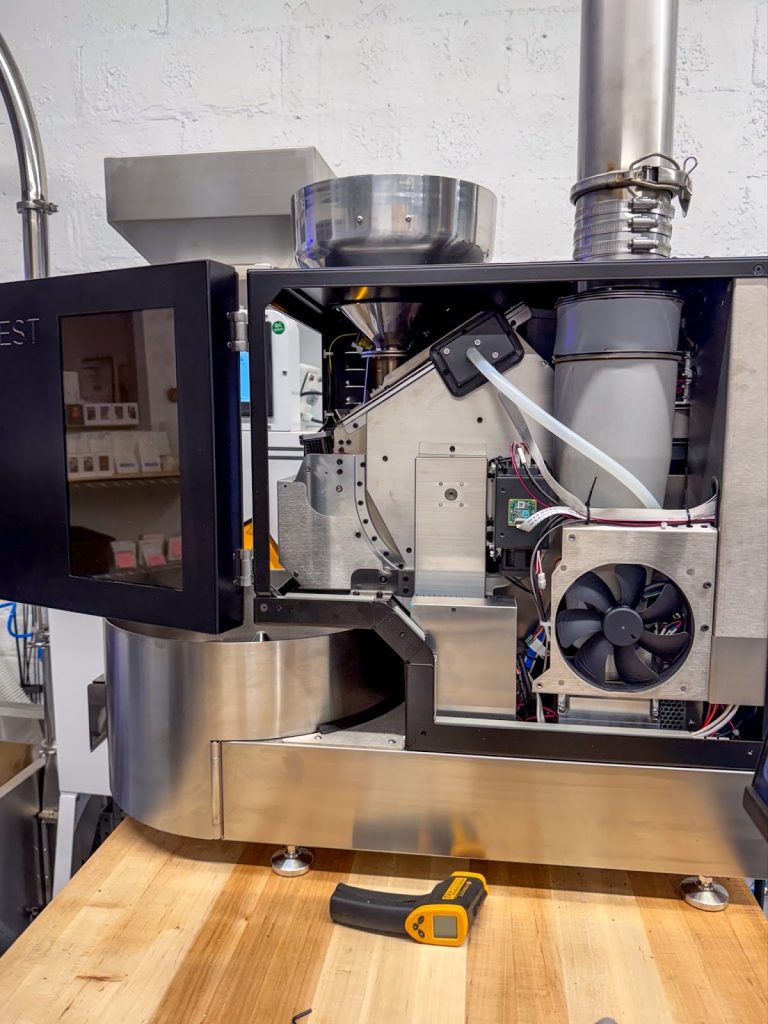
The front of the machine is hinged to enable access to the interior of the machine for maintenance, cleaning and inspection. The internals are tidy and efficient, housed in a metal chassis that serves not only to protect the machine but also dampen sound. While I was surprised by how loud the Stronghold machine was, I was surprised in equal measure how quiet the P3000 is. If not for the vacuum loader sitting to the left of the P3000, I wouldn’t need hearing protection any more; as someone with sensory sensitivities, I found that running production on this quieter machine gave me significantly more mental capacity and stamina, and reduced the stress of a production day.
Visually, the machine matches the square-edged Nordic minimalism of the company’s flagship sample roasters, but scaled up. the “Roest” logotype laser cut through the matte black front plate of the machine anchors the machine’s visual identity.
There’s no trier on the machine (not that I’d use it, anyway) nor a sightglass; in their stead, a high-resolution camera captures the bean pile once per second, throwing an image on the tablet embedded in the front of the machine’s chassis that also serves as its control interface. In its current state, the camera system is more captivating than it is useful, but the ability to have some direct observation over the roast is, regardless, a feature that I’m sure many people will appreciate.
Beyond the camera, the machine seems to be equipped with nearly every sensor the engineers might have thought of:
- four different bean temperature sensors located in different places inside the drum, enabling self-calibration and accuracy across different batch sizes;
- multiple inlet sensors, ensuring accuracy and self-calibration along the inlet air path;
- three drum sensors that average and self-calibrate to provide rapid, accurate real-time measurements of conductive surfaces;
- an exhaust temperature sensor;
- a hopper temperature sensor (for reading the temperature of green coffee);
- a pressure sensor, placed between the inlet and coffee pile (rather than at the exhaust point as in the L200 Ultra);
- a first crack sensor;
- an airflow volume sensor; and
- a humidity sensor.
Combined, these sensors give a more detailed and accurate picture of the coffee roasting process than any other roaster I’m aware of aside from industrial scale machines.
Like its smaller siblings, programming, inventory management, roast logging and cupping of roasts from the P3000 happens via the Roest Connect platform. The software is free to use for all Roest customers, which, I’m told, will continue to be the case for all of the basic functionality—though I have heard that there may in the future be paywalled AI-assisted features. Roest Connect works as well as Cropster and seamlessly integrates with the roaster UI, enabling real-time roast analysis and planning. As I already live on the Roest ecosystem for sample roasting, I have appreciated not needing a separate subscription for roast logging and QC, instead finding every feature I need in the Connect platform.
Not all currently plot data to the company’s proprietary Connect platform—notably absent are the humidity sensor, air volume sensor and hopper temperature, as well as the camera data—but for sensors that do, averaged or individual readings can be displayed for each roast.
The insights these measurements enable—and the world of data they generate—are the key to unlocking the machine’s true capabilities.
While I believe the style of coffee I like to drink—bright, very light, structured coffee free of roast notes or defects—can be achieved on nearly any machine, in the year 2026, I can’t imagine buying a roaster that lacks inlet temperature control. Yet, most small-batch roasters do lack inlet control, from Probat to Diedrich to Loring to Stronghold. Most machines operate analogously to the roasters of yesteryear, with an operator controlling the gas or power delivered to the machine like a throttle, the outcome dictated by the richness of that flame and the BTUs produced. There’s a romantic allure to the pyromancy required, and to me, they’re like classic cars—great for a leisurely Sunday drive on a sunny afternoon, but not what I’d want for long-hauls or commutes on the beltway.
But after receiving feedback from power users Luca Costanza and Scott Rao, Roest responded by releasing a retrofit inlet sensor kit (before making it standard on their L and P lines of machines), and enabled inlet control schemas on those roasters. Through this control system, a user has the ability to set inlet temperatures as a dependent variable (on the Y-axis), pegged either to time or bean temperature (on the X-axis).
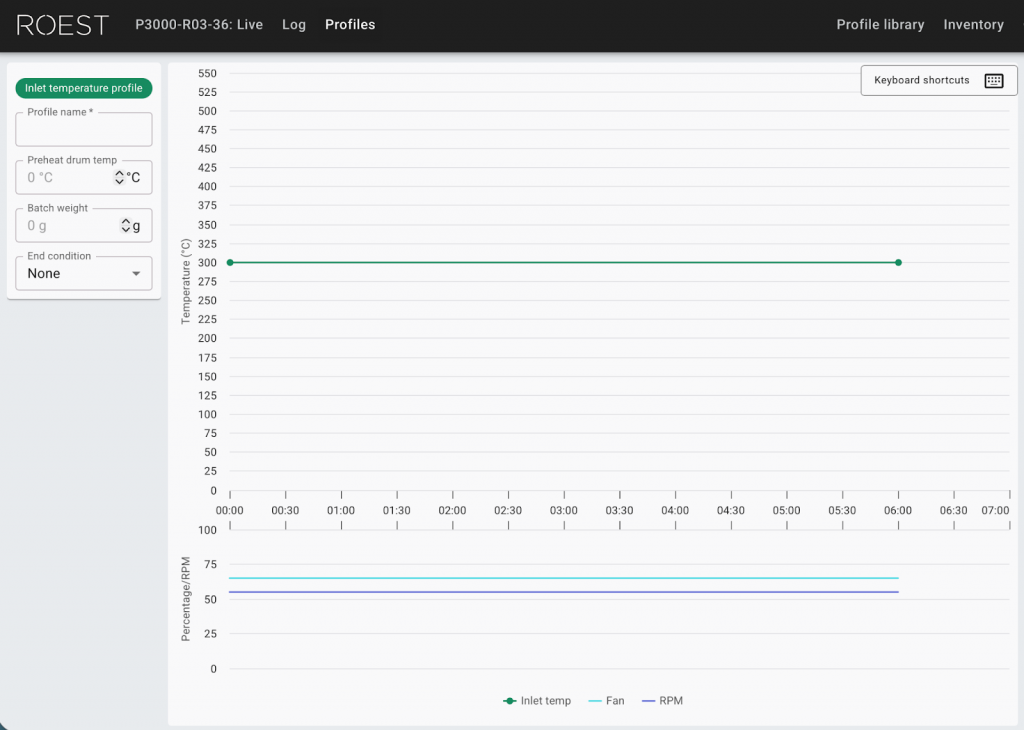
For many newer roasters or those who come from a traditional roaster, it’s a somewhat confusing approach—one of the reasons I still don’t recommend buying a Roest sample roaster for people who want to ‘learn to roast’ even though I consider them to be the best lab roasters on the market—but is the control style used by large-scale industrial machines from companies like Neuhaus Neotec and Brambati because of its robustness and consistency of the results. The advantage, of course, is consistency and control. And indeed: Quality only truly matters insofar as it is consistent.
While the P3000 does allow for manual roasting as well with control over the heating element, drum speed and fan speed as in a traditional roaster, the machine’s primary strength as a production roaster is in inverting the relationship of the control schema via its inlet-setpoint control system. Having years of experience using this style of control schema—both on larger machines as well as on the smaller Roest sample roasters—I found it quite easy and natural to use this approach in which an operator programs pre-set inlet settings—either based on time or bean temperature values—as well as corresponding fan and drum speeds. Unlike in its smaller brethren, a single fan drives the roasting process for the P3000 separate from an independent cooling fan. In practice, this makes roasting with the P3000 quite a bit simpler than the sample roasters. Free from the effects of backpressure resulting from the two-fan configuration, an operator has the freedom to simply modulate air speed by increasing or decreasing the heater fan.
During a roast, the P3000 adjusts the power delivered to the heating element to produce the inlet temperature desired. This is a fundamentally more stable, consistent and predictable control system than traditional burner control; while burner control suffers from sensitivity to ambient temperature, for example, or gas mixture or voltage, inlet control gives operator dictate over the air temperature driving the actual roasting process.
Flat-inlet profiles work remarkably well on the P3000, particularly for lighter roasts, and by adjusting fan speed a user can push a roast faster or slower as, in tangential convection roasters, the rate of heat transfer is directly correlated with airspeed. In practice, airspeed and temperature work together in air roasters to modulate the coefficient of convective transfer: higher air speeds require lower inlet temperatures for a roast with equivalent time to one with lower air speeds. Each approach may produce slightly different cups and the texture, cup densities and fruit presentation of a coffee, and enabling an operator to dial a roast, if desired, to take on more “drum roaster”-like character, if desired.
I found I was able to get immensely drinkable results quickly by starting with a flat-inlet profile then slowly modifying it to explore the relationships between airspeed and temperature in the machine:

To change an automation program on the Stronghold, it requires that a user re-perform the roast manually, making the changes desired and capturing the results to run as a replication roast under a separate profile—and exposing me to fluctuations in incoming voltage. In the P3000, though, I can iterate rapidly, making the desired changes through the designer on the Connect platform, allowing for more granular changes and greater consistency in the parts left unchanged and with a full, iterative history view of a profile. It’s a stress-free, simple undertaking and a workflow will be familiar to anyone who has roasted using one of the smaller Roest sample roasters, an Ikawa or Kaffelogic.
Because of this, I found it easier and faster to dial in coffees on the P3000 versus the S9X and with fewer kilos expended on profiling. The lower drum temperatures of the P3000 system and more precise control over air temperatures and airspeed meant I could improve inner development without introducing roastiness and could modulate my development gradient intentionally—rather than haphazardly, and quickly adapt a base profile to a coffee’s individual physical characteristics and tendency to absorb heat.
In December, I re-released every coffee Aviary roasted in the 2025 season, roasting them on the P3000 while they previously had been roasted on the S9X. I had just 6 kilos of each—only two batches, and two attempts to get it right. Because of the strength of the P3000’s control system and its predictability, I preferred every single one roasted on the P3000 over its original release, finding them more vibrant, aromatic, sweet and dynamic with no noticeable roastiness present.

It’s perhaps a bit counterintuitive to move to a smaller roaster as a company grows. Indeed: the P3000 boasts less than half the per-batch capacity of the S9X. Less capacity, in most cases, creates bottlenecks; with bottlenecks come longer days, more labor, higher costs and slower growth.
But my hope was that because of its engineering and heat application, I might be able to achieve equivalent production capacity using the P3000—even while limited to smaller batches. As in the L200 Ultra, the P3000 roasts using ‘counterflow’, pushing the coffee pile with paddles rotating into the incoming inlet air rather than away from it. This design allows for greater efficiency of heat transfer and the utilization of lower air temperatures for the same roast speed by reducing the amount of air that bypasses the coffee pile en route to exhaust.
This approach also enables the tiny P3000 to roast a full 3 kilo batch incredibly quickly—and using very little power. While the S9X, according to the company documentation, technically only requires 34.3kW, running the Maddox step-up transformer in my facility required more headroom at 75kW; the P3000 fed directly from the 240v panel and required, at peak, just 10.24 kW. I opted for a NEMA L14-30 plug and receptacle rather than direct wiring the machine to a shut-off, enabling me to unplug the machine for cleaning, maintenance or relocation.
The rated capacity of the Stronghold was 8kg, which it is capable of, to be sure—but it would require a somewhat more aggressive heat application and slightly longer roast times as well as longer between-batch time (due to hotter finish temperatures in the roaster). Besides: I typically receive coffee in vacuum sealed bricks divisible by 6 (12kg, 30kg), making a smaller batch size more manageable and optimal from the perspective of materials handling. And so my typical batch size on the S9X was 6kg, which I roasted, including the short delay at the start of each roast imposed by the machine, in approximately 9 minutes. The between batch protocol for my roasting style and this batch size generally took 5-6 minutes—meaning that I could roast one batch every 14-15 minutes, or around 4.2 roasts per hour, giving a throughput of approximately 25.2 kilograms of green coffee per hour—at best.
This number—25 kilos per hour—is the same that Roest markets for the P3000.

As a result of the machine’s efficient heat transfer, I’ve found that the P3000 can indeed roast a full 3kg batch in 6 minutes. By charging at a slightly higher drum temperature (215-220º depending on the hopper temperature reading at charge) and using a between batch program that turns off the heating element and increases the blower fan to 100%, it’s possible to recover to charge temperature between batches in approximately 1:00. Even factoring the 0:15 delay at the beginning of each roast as the hopper empties into the drum, I could, if I wanted to, roast one batch every 7.25 minutes, or 8.3 batches per hour—yielding a throughput of 24.8 kilograms of green per hour, or just 400g less than I was achieving on the much-larger S9X.
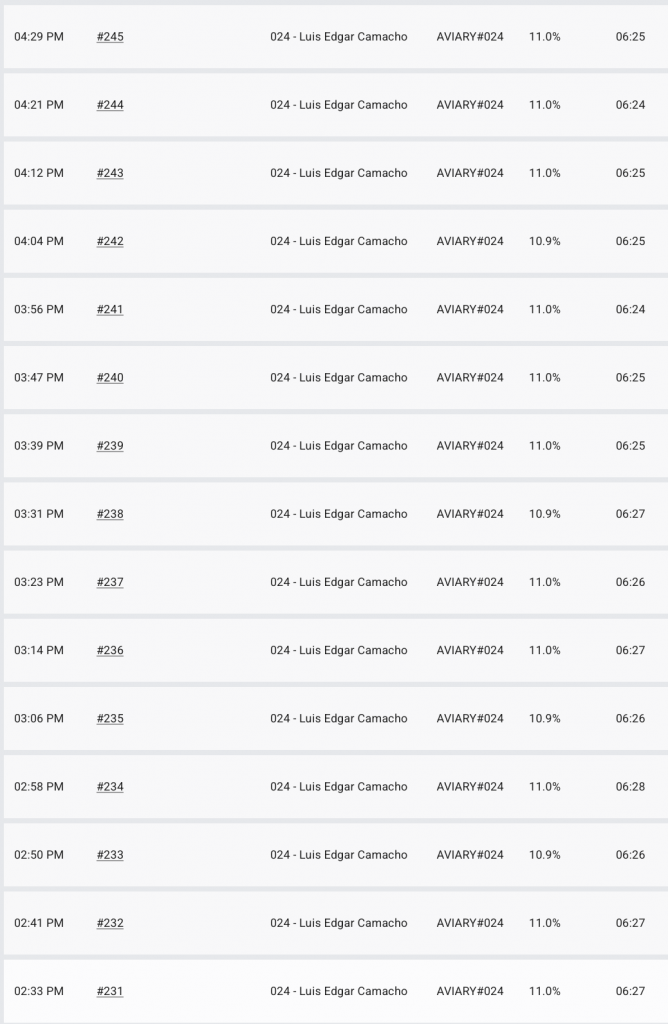
I’ve tested this theoretical speed in recent production runs for Aviary, slowly increasing the speed of the roasts as I gained confidence that the faster roast speeds would not have detrimental effects on either cup quality nor shelf life. My approach for a washed Pink Bourbon from Luis Edgar Camacho (released as AVIARY#024), which I roasted in 6:25, required a peak power of 70%, suggesting that if I want to, I can push the roast even faster.
Over 34 roasts, I emptied the chaff barrel every 11 or 12 batches during the BBP process after the Inlet temperature had dropped below 60º, meaning no lost time or efficiency for this crucial step that required manual intervention.
After each batch cooled, it dropped from the tray into a bucket sitting on a scale (manufactured by Arlyn) that automatically logged the yield and time to Google sheets. As one batch cooled, another was roasting; another was processing in the color sorter, and after sorting was lifted through a destoner into the Sovda Precision Fill Mini, ready for bagging and sealing on a band sealer. In down time between and at the finish of the day as the roaster cooled, I’d seal the bags and tuck them into their retaill boxes.
I have yet to run a 6:00 profile for a full production profile run (rather than one-off roasts)—but even 25 seconds slower, my actual, real-life, observed throughput was 22.3 kg per hour.
With this workflow, in just shy of 5 hours, I was able to roast, sort, bag, seal and box what started as 99 kg of green coffee.
The promised feeder system being developed by Roest will enable this lightning speed to happen automatically, without intervention required from an operator to weigh, start, terminate, cool or drop a roast. But by using a $600 weigh and fill from Alibaba, I was able to achieve this speed of workflow semi-automatically by dispensing 3000g of green ahead of each batch and utilizing the roaster’s inlet-time profiles and automated BBP.
Far more than speed, though, the question for a company like Aviary—which must meet exacting and mercilessly competitive quality expectations—is how consistently a machine can produce high-quality roasts, and how flexible of an instrument it is.
There’s a notion in the world of indie specialty coffee roasters that “small-batch” roasting is superior. The phrase adorns the packaging and marketing materials of countless brands and many companies, driven either by superstition or the memory of legendary coffees from a bygone era of roasting, actively resist up-sizing their machines even as their volumes grow. While no doubt some of it amounts to self-soothing over budgetary constraints, I do suspect there is a bit of folk wisdom to the idea, if only as an anachronism: in the days before Cropster and data logging, quality roasting depended on an operator’s skill, senses and intuition. Any reasonably well-engineered machine can, I think, produce good coffee. But each machine, by virtue of its design, may offer distinct advantages or disadvantages that lend itself to one approach or style over another, or may lend itself to ease of consistency. Smaller roasters offer a greater ease of observation as well as lower risk by virtue of smaller batch sizes—enabling more boundaries-pushing approaches and iteration.
But more batches introduces more opportunities for variability, and if I had my druthers, I’d typically prefer a larger roaster. I relish the experience of working with my clients’ 120+ kilo capacity roasters because, in my experience, larger roasters tend to offer greater consistency.
Using the P3000 for 4 months, though, I find I have confidence that not only will the first and last roasts of the day match—in terms of color, weight loss, roast times, and cup—but so will all the roasts between. And, if a roaster accounts for changes in ambient temperature by adjusting the drum temperature at charge such that roast times match, so too will roasts be consistent for a coffee roasted to the same profile on different days.

Because of the small batch sizes I roast at Aviary, I’ve used scales that read to 0.2g, giving me a high-resolution understanding of the variance in roast loss I’ve experienced between the two production roasters I’ve used:
Roast Loss Variance
| Coffee | Stdv | ||
|---|---|---|---|
| Stronghold S9X | Layo Teraga, Site 1, Washed, G1 | 0.25% | |
| Kerehaklu Estate Lot E | 0.16% | ||
| Tagel Alemayehu, Hambela, Washed, G1 | 0.39% | ||
| Finca San Jeronimo Gesha Washed | 0.26% | ||
| Arturo Paz Gesha DRD | 0.14% | ||
| Yusuf Al Aamal Honey 2025 | 0.15% | ||
| Roest P3000 | Sergio Caro Chiroso | 0.03% | |
| Shibru Dube, Chelchele, Washed, G1 | 0.04% | ||
| Bekele Yutute, Murago, River Submerged Anaerobic, G1, LOT03279 | 0.02% | ||
| Luis Edgar Camacho Copa de Oro Pink Bourbon | 0.04% |
The average of the standard deviation of roast loss across the last six Aviary releases of 2025—a total of 146 batches in total, all roasted on the S9X—was 0.23%; in a 6kg batch, this is +/- 13.8g.
The first four releases of 2026, meanwhile—157 batches, all roasted on the P3000—averaged just 0.04%. This is a variance of just +/- 1.2g in a batch of 3kg.
In other words: in my experience, the P3000 offers the consistency of a much larger machine but in a small-batch format.
No machine is perfect, even those I love, enjoy using and would buy again. How problematic a machine’s flaws are, though, might range from small irritations—like my complaint about the Kaffelogic’s absurdly short and not detachable power cord, or Stronghold’s bizarre choice of placing coffee-shaped ventilation holes directly next to the green hopper—to more serious faults.
Fortunately, for the P3000, most of the problems I’ve identified are merely quirks or minor irritants—like the small size of the chaff barrel—and many of which I expect will be solved with future software updates. And, to be sure, I have provided my feedback thus far about the machine to the team at Roest and look forward to seeing further refinement as I continue to use the machine.
I’ve had issues with the first crack detection; it worked for the first 100 or so roasts, but in more recent roasts doesn’t trigger until crack is well underway. This, I believe, is possibly related to the beta version of the firmware I’m currently using, though, and I’m in discussions with the support team about it. I don’t necessarily rely on this sensor, though—I expect crack will come some time between 198-200 depending on the coffee and adjust my end temperature by anticipating crack from the visual log.
During one roast, I experienced a drum motor jam. I suspect a chip or piece of coffee broke off and lodged itself in the paddles, causing them to seize. In response, to prevent a fire and to protect the motor from damage, the machine shut off the heating element and prevented further roasting until a reset was performed to clear the jam—a task which I easily accomplished via the debugging menu of the roaster. As a result, though, I lost a full 3kg batch of (quite expensive) coffee. While I have only experienced this one time in nearly 300 roasts, I do believe this is something the company should develop an alternate procedure for handling, either through a quick reverse-direction or by sending additional voltage to the motor to overcome the jam. Chips and brokens are very common in many grades of coffee from all over the world and for those companies who buy those grades of coffees, it’s difficult to recommend the P3000 as a sole production machine until that procedure is more satisfactorily resolved. But as with any questions or issues I’ve had with the P3000 or sample roasters, the support team responded to me quickly and urgently to verify that there was no damage to the roaster and no adjustment required.
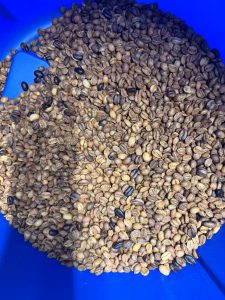
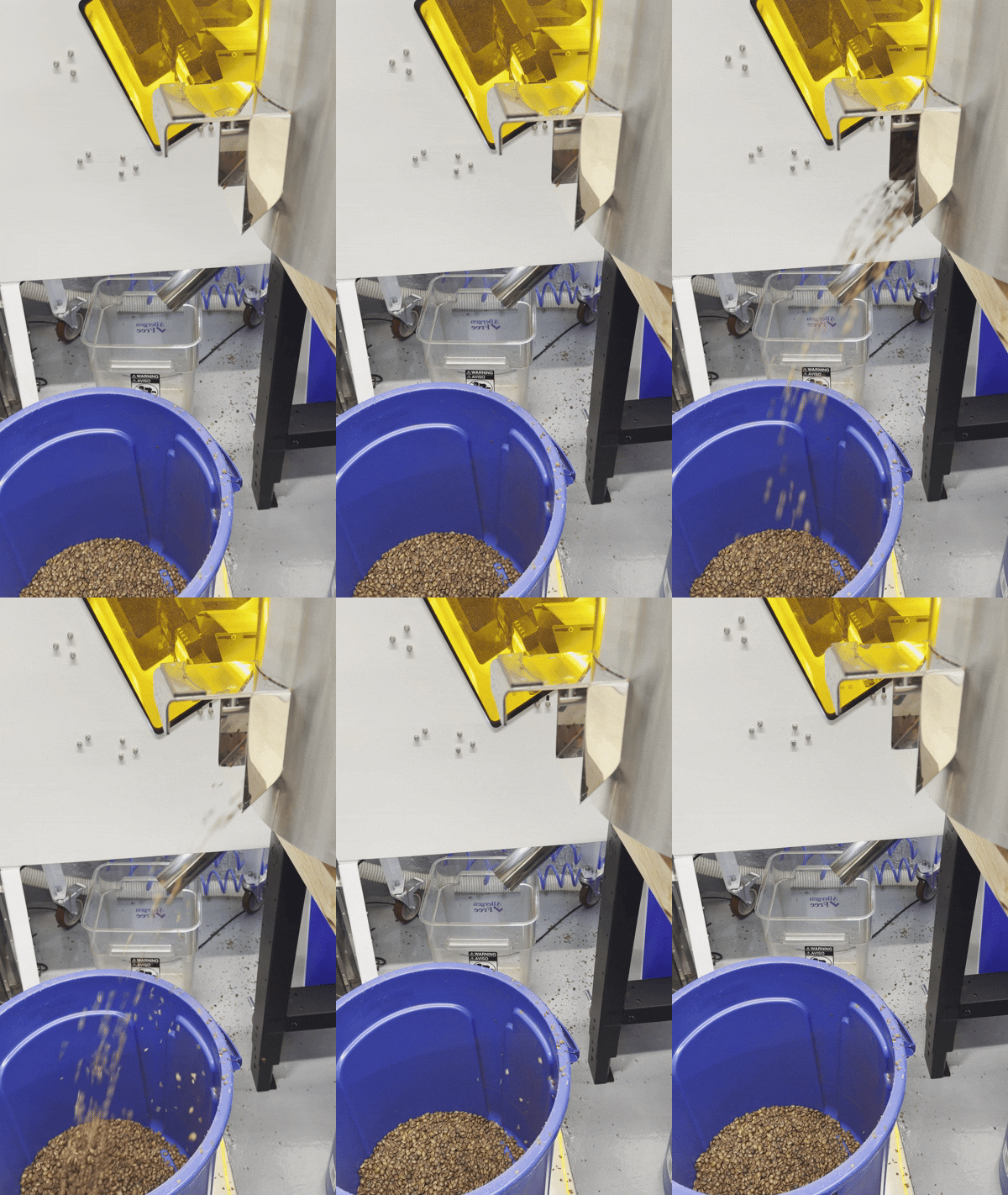
One quirk of the machine—one that is particularly baffling and unexpected—is that it’s not extremely effective at separating chaff from the coffee in the very light style of roasting that I do for Aviary. As a result, by the end of a production day, I find that there is chaff on every surface of the roastery and on all the equipment. It’s plausible to me (I say, somewhat amused) that any variability I’ve seen in shrink is largely due to the chaffiness of the coffee being roasted, as those with higher variability were also those that required more frequent emptying of chaff. One consequence of the high level of chaff present is that the optical sorter I use is less precise and triggers more often as a result of chaff passing by the sensor. In practice, it still effectively removes the bright-orange quakers present, but it also will remove non-quaker material as well, requiring a second sort or else slightly higher rejection rate. To deal with the amount of chaff on the floor and tables at the end of a production day, I’ve 3D-printed a vacuum attachment better suited to cleaning chaff from the various crevices in my roastery at the end of each production day.
Like the chaff barrel, which will fill during the course of a production day, the two mesh chaff filters sitting between the cooling tray and the cold stack will clog with chaff after 15-20 roasts. This will result in impeded airflow and slower cooling times. To address this, I keep a shop vac near the roaster and every so often will quickly open the hinged cooling tray and vacuum out chaff building up in the filters. I requested spares from Roest, though, and in the future will swap them mid-way through production to ensure clean air pathways for the entire roast day.

It’s not possible to download or cast the camera capture data from the machine—either to the Connect platform or USB—and the uncalibrated white balance of the camera limits its actual utility. Because it does not accurately display the coffee’s current color, it’s difficult to distinguish exactly when a coffee changes from green to yellow, for example, let alone tan to brown. I did find a workaround: By opening the front panel of the machine and adjusting the color configuration of the tablet, I was able to pull out the key color change with a bit more clarity, but at the expense of the color balance of the rest of the software. This color calibration, too, is something that the company is working on; I look forward to an update in the future.
Strangely, for a machine that apparently comes equipped with more probes than a Mars rover, there are a few additional probes I’d like Roest to add to their machine, and others (humidity, hopper temp, air velocity) that I wish recorded in the Connect platform. While the ability to detect green temperature in the hopper is incredibly useful for combatting seasonal effects on a profile, missing is any sort of conductivity, proximity or photo sensor to detect if green is loaded at all. With the addition of this sensor could come a fool-proof auto-charge feature—a feature that I think should be added, in any case. I suspect, though, that with the feeder system coming soon, a solution for auto-charging will be implemented soon through a software push.
Also missing is an Infrared temperature sensor in the bean cooling tray, which would enable running the cooling fan until the coffee cools to a set temperature. Currently, it’s also not possible to set the duration for which the fan runs at its highest setting—a feature that would be nice to implement through a future update.
The requirement of using the Connect platform—a well-designed, user-friendly and full-featured software tool which also happens to be one of the machine’s strengths—is also a potential weakness. Though the machine can store 10 profiles on its internal memory (plenty sufficient, in my experience), it does not cache roast history on the machine, making it impossible to recover roast data should Internet connectivity drop mid-roast—an eventuality that I’ve experienced once so far. While an internet connection is not required to operate or roast on the machine, in addition to live roast logging, it is required currently to upload new profiles to the machine via Connect. I hope that in the future Roest will consider licensing the software such that it can be run offline through a local server as well as editing profiles directly on the machine’s tablet. The Ethernet port present on the machine, at least, allows for hard-wiring the machine to a router to ensure a more stable and low-latency connection.
In addition, I’d like to be able to program audible alerts or alarms—either through the roaster itself or the computer connected to Connect—for events like “2 degrees above charge temperature” or “3 degrees before crack.” These alerts would be particularly useful as a single-person operation where I am often not standing immediately next to the roaster during BBP or roasting.
The Connect platform, too, would benefit from a few more features beyond logging these additional probes and capturing camera data, such as roast scheduling and more rapid entry of roast-loss for prior roasts. I’d hoped to use the Roest API to push roast loss data automatically from my scale to the platform, but as it stands, communication is one way (from Connect to Cropster, for example). As a consultant, too, I’d like to be able to add guest accounts with restricted permissions or different user levels—for example, only allowing a user to cup or review roast logs rather than full permissions to manage inventory and profiles. I’d also love to be able to control the roaster—even if using VNC viewer—from a computer; this would be extremely valuable to be able to mark first crack from the platform, for example, or modify a roast end temperature without having to use the tablet.
Roest has been deliberate in the development, production and distribution of the P3000, delaying release of the machine several years to improve, iterate and be sure they could fully support those machines in service. To my knowledge, I have one of the first handful of machines to be installed in the U.S.—a delay which was a result of this cautious approach, ensuring that one of the early units were to have issues it could be served by a Roest technician (who are all European-based). And indeed, I’m told by the team that since my machine shipped in November, some components have been further hardened.
Anticipating future support needs, though, the company has begun to build a network of service techs across the world—Doug Graf and the team at Vintage are the technicians for my area—who will handle repairs and maintenance of the machine both within and outside of the machine’s 1 year warranty.
As a newer product, the reliability of the machine remains to be seen, though I have confidence not only as a result of the factory warranty but also based on my experience using Roest’s sample roasters for the last 3 years. After all: it’s mission-critical for my roastery. If it goes down, I can’t produce.
Over thousands of roasts, though, I haven’t experienced any major issues with the two other Roest roasters I own, and when I did have an issue with my L100 Plus (a faulty encoder that in no way impacted the machine), the team dispatched a repair kit quickly. As a Norwegian company governed by the EU’s world-leading right-to-repair regulations, Roest provides a parts shop as well as detailed video and written guides for repair and maintenance of their machines on the service portal.
It’s my hope and expectation that the machine will operate for years to come, even under heavy volumes of use, provided that users are mindful of maintenance and cleaning requirements for the machine—which are far easier and faster to complete than those of a traditional drum roaster (as anyone who has cleaned a Diedrich IR-15 with an afterburner can attest to).
I have requested that Roest send me a spare parts kit containing all of the most failure- and wear-prone components of the machine based on their history thus far—fuses, heating elements, and probes—but I do anticipate adding a second P3000 to my bench in the future so as to not only increase my capacity but also have redundancy in the case of a service issue.
I sometimes wryly refer to Aviary as a ‘vanity roasting project’ because, in truth, I started the company not only because I wanted both to showcase my work as a buyer but also because, simply: I wanted to roast the coffee that I like to drink, and I wanted to do it in a way that inspired joy or curiosity for me personally—including through the tools I used. I see myself as a recording engineer or producer, doing what I can to take the sound produced by an artist—the coffee producer—and package it in a way that will connect with the world.
I do this, of course, because I’m a fan of the music.
Every year, hundreds or thousands of samples pass through my lab as part of my work as a consultant and buyer. Of those, there were many that I couldn’t help but wish I had the opportunity to present to the public myself—coffees that I’d treasured every gram of, slurping the cold liquid from the bowl after the cupping was complete until my mouth filled with sludge and grounds.
The tools I seek are those that help me scale this experience from private, guarded exhilarations to thousands of units shipped, sipped and shared around the world. But after two years of working on a different production machine, I felt my joy slipping as both the project and my frustration grew.
On playback, I’d found too often that the demo was better than the final mix.
And, so I made a change. In the P3000, I’ve found a machine that helps me render a world I’d very much like to live in: vibrant, bright, and stable.
Tags: aviary p3000 production roasting roest
This was a really great read. I am currently starting my own venture in the coffee-roasting world, and the folks at Roest have really caught my eye. I’m planning to check out their booth in San Diego this April to learn more before deciding which sample roaster and production roaster to go with. Perhaps you’ll be there, and we can meet up.
Thank you for taking the time to write such an in-depth analysis and review. The data you presented was awesome. I was totally geeking out for a bit and loved it.
One thing I was curious about: based on what you’ve seen so far, do you think the P3000 could realistically replace a traditional 5–12kg drum roaster for production in smaller specialty roasteries, or do you see it fitting more as a complementary system?
Hey Anthony, thanks!
Yes, I do think it’s a reasonable replacement for a drum roaster, specifically. The workflow, consistency and lower cleaning/maintenance requirements of the machine are specific call-outs I’d make.
Compared to an IR-12 with an afterburner, for example, a machine with a rated capacity of 12kg per batch. It can’t roast and cool simultaneously, of course, and can really only comfortably roast about 7kg per batch reasonably quickly. The between-batch time is, at fastest, 7 or 8 minutes (provided you start with 100% air in the tray, then switch to 50/50 to cool the drum after 90-120s, then 100% air after the coffee is out of the cooling tray). This means that you’re looking at, at best, an 8-9 minute roasts with 7-8 minutes between—in other words, about 4 batches an hour, or a throughput of 28kg of green per hour…. just 3kg more than the Roest. Cleaning the machine, though, takes hours in comparison to mere minutes for the Roest.
Really appreciate this level of detail, care and transparency to share this is very insightful. We’ve been considering upgrading to the P3ooo once demand justifies it, so this came at a perfect time, and gave me personally even more insight on how much it can really optimize the workflow especially for a roastery being run by 1 person, for now..
The fact that ROEST seem to be good at taking feeback and acting on it, makes me think (or maybe hope) that by the time we’re upgrading, they would have updates for this machine that would make it more efficient, and more consistent if that’s even possible.